HVAC Dispatching Tips for Small Shops That Run 2 to 30 Trucks
Practical HVAC dispatching tips for owners and office managers: triage calls, match techs to jobs, cut drive time, handle emergencies and measure results.

HVAC Dispatching Tips for Small Shops That Run 2 to 30 Trucks

Good HVAC dispatching comes down to five habits: triage every call the same way, send the right tech with the right parts, group jobs by geography, tell customers and techs about changes the moment they happen, and review the board every day. A small shop can do all five without a big dispatch department. It needs written rules and one board that everyone trusts.
This guide is for owners and office managers who dispatch themselves or have one person doing it. Everything here works with a whiteboard. It works better when the board lives on the techs’ phones.
TL;DR
- Triage first, assign second: sort every call into immediate, same-day or next-business-day before you look at who is free.
- Match the job to the tech’s skill, certification and truck stock, not just to whoever is closest.
- Dispatch by area, keep a buffer for emergencies, and move jobs on the board the moment plans change.
- Text customers when the tech is on the way, and write down every bump so the whole office can see why.
- Review the day each morning and each evening, and track a few measures you can act on.
Table of Contents
- Triage every call before you assign it
- Match the tech to the job, not just the calendar
- Cut drive time with geography and a realistic day
- Handle emergencies and schedule changes without chaos
- Keep techs and customers informed as things change
- Build a daily routine for a small dispatch team
- Measure dispatching so you can improve it
- Perspective
- Put the board on the phone
- FAQ
- Sources
Triage every call before you assign it
Urgency should decide who goes first, not who called first. A simple three-level scheme keeps this fast enough for a busy phone:
- Level 1, dispatch now: no heat in freezing weather, no cooling for a vulnerable household, gas smell, burning smell, water actively leaking from equipment.
- Level 2, same day: system running but not keeping up, a noisy or short-cycling unit, a repeat visit on a recent repair.
- Level 3, next business day: tune-ups, estimates, maintenance agreement visits, comfort complaints with no failure.
Write your own versions of these levels down, with examples from your own market. Your Phoenix summer list will not look like a Minnesota January list. The point is that the call taker and the dispatcher apply the same rules, so a call gets the same answer no matter who picks up the phone.
Ask the same questions every time
A short script pays for itself. Capture the address, the callback number, the equipment type and age if the customer knows it, what the system is doing, and whether anyone in the home is at risk. If the customer is a repeat, pull up the job history before you hang up. Knowing that a unit was serviced three weeks ago changes who you send and what you tell the customer.

When a caller describes a gas smell, treat it as a safety call, not a scheduling call. Follow your written safety procedure and your local utility’s guidance on what to tell the customer, and do not leave it sitting on the board.
Match the tech to the job, not just the calendar
The cheapest truck roll is the one that finishes the job. Sending the closest open tech to a commercial refrigeration problem or a boiler lockout wastes a visit if that tech does not work on that equipment.
Build a simple skills grid, one row per tech, and keep it next to the board:
| Tech | Residential split systems | Heat pumps and mini-splits | Boilers and hydronics | Light commercial | Can run solo |
|---|---|---|---|---|---|
| Example tech A | Yes | Yes | No | No | Yes |
| Example tech B | Yes | Yes | Yes | Yes | Yes |
| Example apprentice | Yes | Learning | No | No | With a certified tech |
Fill in your real crew. Update it when someone finishes a training class or gets a new license.
Certification is a dispatch issue
In the U.S., EPA Section 608 rules say anyone maintaining, servicing or repairing equipment that could release refrigerants must hold the right technician certification, and apprentices are covered only while under the continuous supervision of a certified technician. For the dispatcher, that means an apprentice is never the only person on a refrigerant job. Put certification level on the skills grid and check it before you assign.
Think about the truck, too
The right tech with the wrong parts is still a return trip. Use what the call tells you: a capacitor or contactor call needs different stock than a failed blower motor. Where a repeat customer has a known model, note the common parts on the job. Ask techs to tell you when a part runs low on the truck so you stop sending them to jobs that need it.
Cut drive time with geography and a realistic day
Windshield time is a cost you pay on every job. Two habits do most of the work.
- Cluster by area. Split your service territory into zones. Fill each tech’s morning from one zone and the afternoon from a neighboring one. When a new same-day call comes in, look for the tech already nearest to it, not the tech who just finished.
- Schedule real durations. A flat one-hour slot for every call is how the afternoon falls apart. Give a tune-up, a no-cool diagnosis and an install walkthrough different default lengths based on how long your techs actually take. Adjust after a month of real data.
Leave some slack. A board packed solid from 8 to 5 has no room for the Level 1 call that will arrive at 10:40. Many shops hold one open window per tech per day, or keep one flexible tech for emergencies, and fill it with Level 3 work that can move.
If scheduling eats your mornings, our guide on how to reduce field service scheduling time walks through the steps in more detail.
Handle emergencies and schedule changes without chaos
Emergencies are where small shops lose their rhythm. The fix is a written rule for when an emergency is allowed to bump a booked customer.
- Validate severity against your written criteria. If the call meets your Level 1 definition, it qualifies. If it does not, it goes where it fits.
- Pick who gets displaced. Move the most flexible job first: a maintenance visit before a diagnosis, a diagnosis before a paid install day.
- Notify the displaced customer right away. Call or text with a new window and a short reason. Customers forgive a move they hear about early.
- Write down the decision. Note who was bumped, why and who approved it on the job record.
That last step feels like paperwork until the first time a customer asks why they were moved, or a tech asks why their route changed. A record turns an argument into a lookup. It also lets any person in the office pick up the board without a handover chat.
For a fuller walkthrough built around phones in the truck, see our emergency dispatch protocol for small shops.
After-hours calls
Decide in advance who takes after-hours calls, what qualifies for a night dispatch and what waits until morning. Put the rotation and the criteria on paper so the person on call is not making policy at 2 a.m.
Keep techs and customers informed as things change
Most customer frustration comes from not knowing, not from the wait itself. A few small habits remove most of it:
- Send a confirmation when the job is booked and a reminder before the visit.
- Send an arrival message when the tech is on the way, with the tech’s name.
- Tell the customer immediately if the tech is running late. A text takes seconds.
- Make sure the tech sees job notes, photos, address and gate codes on the phone, not on a paper ticket back at the shop.
Reminders also protect your schedule: a customer who is reminded is more likely to be home. Our piece on text appointment reminders for service shops covers how to set them up.
Techs need the same clarity in the other direction. Ask them to update status at three points: on the way, arrived, and done. When the board reflects reality, you can answer “where is the tech?” without calling the tech. That keeps them focused on the work and keeps the dispatcher off their phone.
Good tickets make the next dispatch smarter
What techs record on a job feeds your next decision. ENERGY STAR’s guidance on service contracts says owners and managers should require detailed service tickets, including task sheets and equipment measurements such as motor amps and volts, so changes can be tracked over time. That applies to your own maintenance customers as well. A dispatcher who can see last year’s readings can send a tech with a likely part in hand and a heads up on what to look at.
Build a daily routine for a small dispatch team
A small team does not need a complicated process. It needs the same two check-ins every day.
Morning (10 minutes):
- Walk the board with the techs or send it ahead of time.
- Flag jobs that need special parts, permits or a second person.
- Confirm who holds the open emergency window.
- Look at the weather and expected call volume, and adjust.
End of day (10 minutes):
- Close out jobs that are done and move any that are not.
- Check that notes, photos and materials are on each job.
- Place tomorrow’s callbacks and follow-ups.
- Note anything that went wrong so it gets fixed this week.
If you are the owner and the dispatcher, hold these check-ins with yourself on a calendar. If someone else dispatches for you, a short daily conversation with them is one of the best ways to keep a good dispatcher. It shows you care about how the work goes for them and gives them a place to raise problems before they become resignations.
Ride along
Have your dispatcher spend a day in a truck now and then. Seeing how long a diagnosis takes, how hard parking is at an apartment complex or what a tight attic does to a schedule improves every booking they make afterward. It also builds trust between the office and the field.
Measure dispatching so you can improve it
You do not need a dashboard full of charts. Pick a handful of measures and review them weekly:
- Callbacks and repeat visits: a sign that matching or diagnosis is off.
- On-time arrival: compare the window you promised with the actual arrival.
- Jobs completed per tech per day, read alongside drive time and job type.
- Time from call to dispatch on Level 1 calls.
- Same-day cancellations and no-shows: a sign that reminders or confirmations are not working.
- Revenue and margin by job type: so you know which calls deserve priority on a full day.
The last one matters most for profit. If a repair visit on a failed system tends to turn into a replacement estimate, that call deserves your best-suited tech. If you cannot see job cost, you are guessing. For the wider picture, our seven steps to improve field service efficiency connects dispatch to the rest of the operation.
Perspective
We built MEPflow because we are a master plumber, a master electrician and an HVAC technician, and we have all lived on the wrong end of a bad schedule. A tech who gets a job with no notes, no parts plan and a drive across town does not blame the dispatcher. They blame the shop.
Our view is that dispatching is only as good as what the dispatcher can see. The schedule, the customer history, the job photos, the materials and the status updates should all live in one place that the office and the truck share. When the tech updates a job from the driveway, the office sees it at once. When the office moves a job, the tech sees it at once.
That is why the app is mobile-first and works offline. Basements, rural properties and mechanical rooms do not always have signal, and the work cannot stop for that. Photos, materials and job status sync when the signal returns, and the full desktop office side runs on the same data.
We also think software should not make you pay more to dispatch better. Every feature is on every plan. Plans differ only by how many people are on them. You get scheduling and dispatch, estimates, invoicing, job costing, customer texting and the trade calculators on day one, whether you run two trucks or thirty.
Write your triage rules down, keep one board, and review it daily. Then pick tools that make that routine easy to keep.
Jonathan
Put the board on the phone
If your dispatching still runs on a whiteboard, a spreadsheet and a lot of phone calls, the habits above will help right away. They get easier when scheduling, texting, job notes and invoicing sit in one app.
MEPflow is field-service software for plumbing, HVAC and electrical contractors. It covers scheduling and dispatch, Good/Better/Best estimates, invoicing with payment links, job costing, customer texting with arrival notifications and live fleet tracking. It works offline, and we import your existing customer and job data for you. Billing is month to month with no contract and no setup fee. For pricing, see the pricing section on our home page.
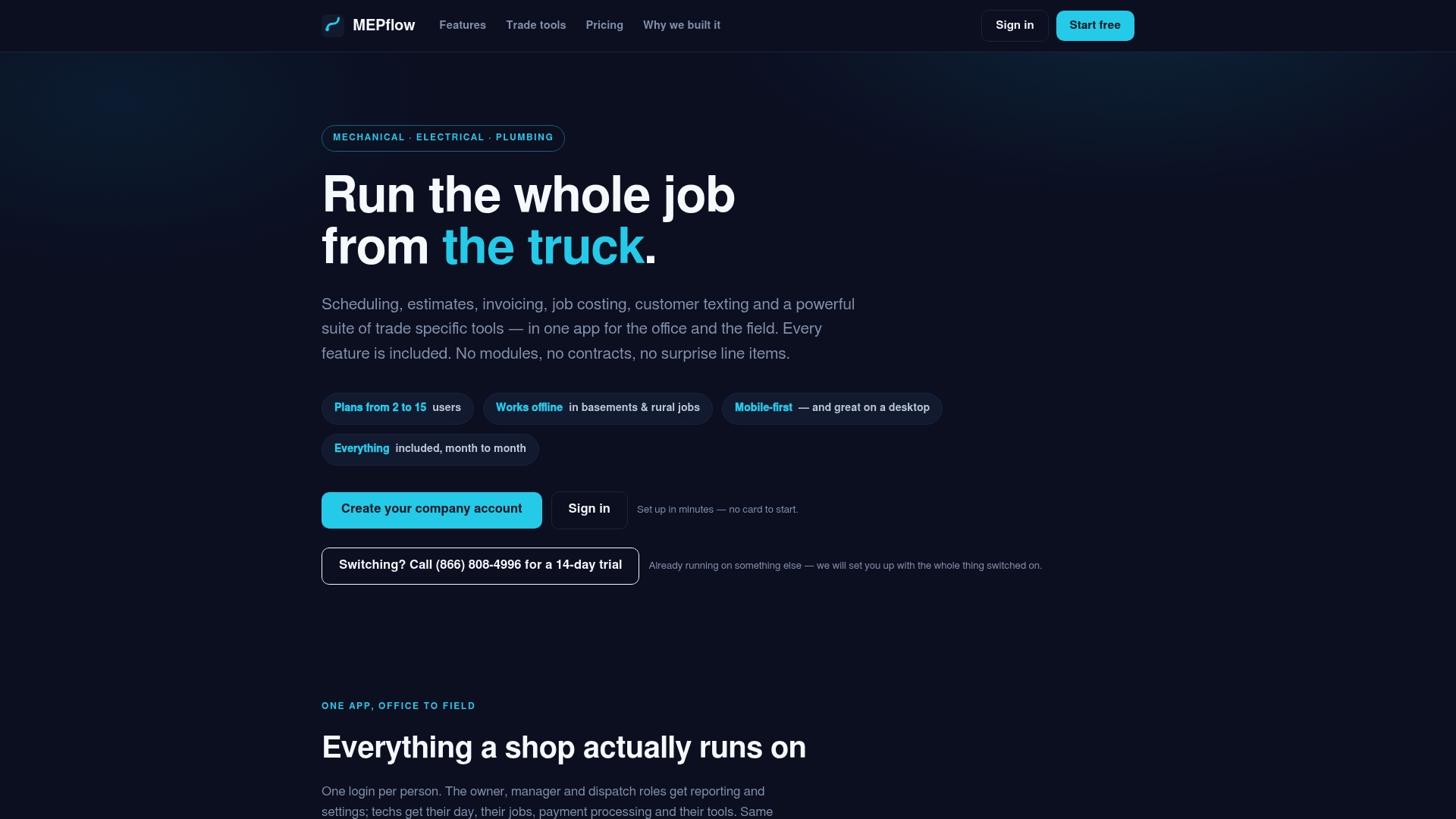
Free signup is capped at 5 customers and does not include the trade tools. If you want the 14-day trial, call 866-808-4996 to book it. When you are ready to start, Create your company account. To see how the app works on a phone without signal, read about testing mobile field service software offline.
FAQ
Is being an HVAC dispatcher hard?
It can be, because the dispatcher juggles urgent calls, tech availability, customer expectations and changing weather all day. Written triage rules, a skills grid and a single shared board take much of the guesswork out. Protect the role with sensible hours and a backup, since a worn-out dispatcher makes poor calls.
How do I become a better dispatcher?
Start by learning the work: ride along with techs, learn how long common jobs actually take and learn which parts fail on which equipment. Use the same call script every time and write down your decisions on bumped jobs. Review callbacks and late arrivals weekly to see where your matching can improve.
What should a small shop dispatch from: a whiteboard, a spreadsheet or software?
A whiteboard and spreadsheet work when you have a couple of trucks and few changes. They struggle once calls shift during the day, because the techs cannot see updates and the office cannot see job status. Software with a shared mobile board removes that gap, and it is the point where most growing shops make the switch.
How do I dispatch an apprentice safely?
Treat the apprentice as a second person on a job with a certified tech, never as the only person on refrigerant work. EPA Section 608 requires certification for work that could release refrigerants, and apprentices are covered only under continuous supervision by a certified technician. Put that rule on your skills grid so it is checked at every assignment.
Sources
- EPA: Section 608 Technician Certification Requirements
- ENERGY STAR: Operations and Maintenance Service Contracts
Recommended
Where to next
- See what MEPflow doesScheduling, estimates, dispatch, invoicing and job costing in one app.
- Create your company accountSet your shop up in a few minutes. No card to start.
- Field Timesheet Approvals: A Workflow for Trade ShopsMore from the MEPflow blog
- Credit Card Surcharge Rules for Contractors: What You Can ChargeMore from the MEPflow blog